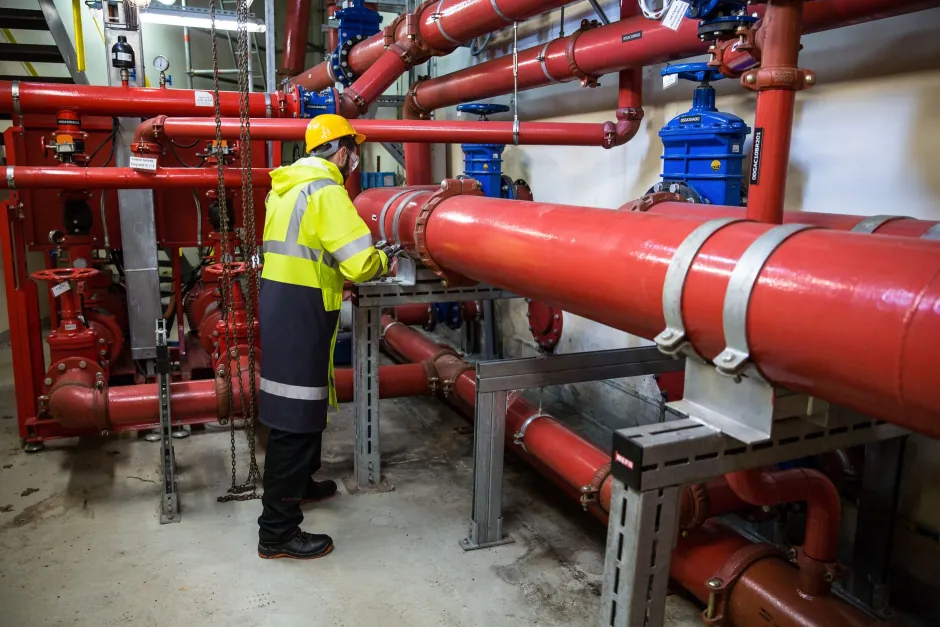
Located with acoustic, pressure and thermal equipment before anything is opened. In a house like this the plumbing is replaceable and the fabric around it is not.
Online Now!·--:--
In a modern home, finding a leak the hard way is annoying. You open some plasterboard, you patch it, you paint it, and a fortnight later nobody can tell.
In a Burwood Victorian or Federation house the calculation is completely different. Behind the wall is lath and lime plaster. Around it is cedar joinery, pressed metal, a cornice run or tessellated tiles that were made by people who are no longer alive.
Cut into that and you are not doing a repair, you are commissioning a reconstruction, and a convincing one costs several times what the plumbing did. Two exploratory holes instead of one is not a minor difference here.
So we locate precisely first, with acoustic, pressure and thermal equipment that touches nothing. Then one opening, in the right place. That sequence is worth paying for in this housing in a way it genuinely is not everywhere.


Lime plaster and lath will often dry and stabilise. What kills it is water still arriving, and being rushed into removing something that would have recovered.
Lath and lime plaster, cedar joinery, pressed metal, original tiling. None of it is available at a hardware store and a good reconstruction is skilled work.
That flips the economics of detection. Precision is not a premium service here, it is the cheaper option by a wide margin.
Masonry carries moisture without showing it, and water follows joists and bearers to emerge somewhere unrelated to the failure.
So the absence of a visible patch means very little, and the wet spot rarely marks where the pipe let go.
Turn off every tap and appliance, then watch the meter for fifteen minutes. Movement with nothing running means water is leaving the system.
It costs nothing and it works regardless of how well the building is hiding it.
Acoustic listening, pressure testing and thermal imaging narrow a whole house down to a point without a single hole being made.
Only after that does anything get opened, once, where the fault actually is.
Staining is not the same as failure. A great deal of old plaster recovers once the water stops arriving.
Stop the leak, let it dry, then assess. Cutting on the first day removes material that might well have been fine.
Agreed in writing before work starts. These are indicative 2026 ranges. On this housing the detection spend is what keeps the opening small, and the opening is where the real cost sits.
Isolated and stopped, any hour. The damage stops before anything else is decided.
Acoustic, pressure and thermal. A large old house sits at the upper end.
Once located. Access moves this figure far more than the pipe does.
Cheap now, and the worst possible failure in a house full of irreplaceable fabric.
What failed, where, and an honest view on what is likely to dry out and recover.

On a burst the water is isolated before anything else is discussed. Every extra minute is more fabric to dry out.

Acoustic, pressure and thermal testing to narrow the whole property to a single point.

Cut once, where the fault actually is, rather than searching through original plaster and joinery.

Pressure tested before closing up, and a straight view on what will dry and recover rather than what should be cut out.
Shut it off at the meter if you can reach it, then ring. In this housing the difference between ten minutes and an hour is measured in plasterwork.
Call 1300 381 569
Because of what is in the way. In a project home, opening a wall means plasterboard and a coat of paint. In a Victorian or Federation house it can mean lath and plaster, original cedar joinery, pressed metal, tessellated tiles or a cornice run that nobody makes any more. Those are not repairs, they are reconstructions, and a good one costs multiples of the plumbing. So the goal is to open one small area rather than three, and that is entirely a matter of how precisely the leak was located first.
Easily, and in a house of this construction it is common. Water follows the fall of a joist, a bearer or a wall cavity and emerges wherever it can, which may be a room away or not at all. Solid masonry walls can carry moisture for a long time before anything shows on a surface. The reliable test is the water meter: shut everything off and watch it for fifteen minutes. Movement with nothing running means water is escaping.
Acoustic equipment listens for escaping water through the structure, pressure testing isolates which line has lost integrity, and thermal imaging finds the temperature difference a hot water leak leaves behind. None of them touch the building. Between them we narrow a whole house to a point, and only then does anything get opened, once, in the right place.
Not necessarily, and it is worth not assuming the worst. Lime plaster and lath will often dry and stabilise once the water stops, and staining alone is not structural failure. What does destroy it is water continuing to arrive, and being rushed into cutting out a section that would have survived. Stop the water first, let it dry, then decide. We will tell you honestly what we think will recover.
In a house like this, more than usual. A drip that would be a nuisance elsewhere is, in a solid-walled Victorian house, water sitting against materials that do not shed it well and cannot be swapped out cheaply. It is also the version most likely to have been running for months before anyone noticed. The bill for acting early is very small next to the bill for the alternative.
They are among the most common causes of serious water damage in Australian homes, with a service life of about five to ten years. When one lets go it does not drip, it releases mains pressure continuously until somebody reaches the meter. In a house full of irreplaceable fabric, an unattended failure of that kind is genuinely the worst plumbing outcome available, and replacing them is cheap.
An emergency make-safe is $250 to $500. Leak detection is $300 to $600 depending on how much of the house has to be covered, and on a large old house it sits at the upper end. Repair once located is $400 to $1,200 for most jobs, with access moving that far more than the pipe does. Replacing flexible hoses is $150 to $350.
Tell us roughly how old the house is and whether there is original plaster, joinery or tiling near where you think it is. That changes how carefully we work.
Located with equipment before anything is opened, cut once, and an honest view on what will recover on its own.
Online Now!·--:--